
TopVital Indonesia — label literacy
How to Read a Supplement Label
See also: the ingredient guide, and the side-by-side format comparison.
Read the parts of a bottle that carry information: the serving size, the composition list, the registration number, and third-party marks.
Written for shoppers in Indonesia choosing between men's vitamin formulas on a shelf or in an online listing — where the front of the pack is written to sell and the back panel is written to disclose.
This is the page to read before you buy
A label carries two kinds of writing. One kind is information: the serving size, the composition list in order of quantity, the registration number, and any third-party verification mark. The other kind is appeal: short lines chosen because they read well on a shelf. Both are legal. Only one helps you decide.
The method below works the same way for natural supplements for men and for anything else in the category, imported or local. Nothing here is a reason to distrust a brand automatically. It is a way to tell a specific label from a general one in about the time it takes to finish a coffee.
What the front cannot tell you
How much of each herb is inside
Only the composition list ranks amounts, and only individual entries can show them.
How long the bottle actually lasts
Serving size times servings per container gives the real supply length.
Whether the maker tested anything
A percentage on an extract and a verification mark are the visible traces of testing.
Start with the serving size
The serving size is the number the rest of the label depends on, and the manufacturer chooses it. A smaller serving makes every ingredient figure beside it look larger than it would in a bigger scoop. Before you compare two bottles, find out what one serving actually is.
Then check servings per container and multiply the two numbers. The result should match the count printed on the front of the pack. A hundred-tablet pack that serves one tablet a day is a hundred-day supply. If the arithmetic does not land, either the serving or the count is misread, and it is worth looking again before you buy.
What to find on the panel
Serving size, written as tablets, capsules, or scoops. Servings per container. Total units in the bottle.
The arithmetic
Serving size multiplied by servings per container. Compare the result against the count on the front.
Why it matters
Two bottles can look like the same value while one lasts twice as long. The daily cost is what you are actually choosing between.
Where people slip
Reading the capsule count as the dose, or assuming one serving is one tablet when the pack says two.
See also: the energy and endurance formulas page, where serving size changes the comparison most.
The composition list, in order
Ingredients are listed by quantity, largest first. That order is more informative than any headline claim on the front of the bottle, because it tells you what the formula is mostly made of. When you see a vitamin and mineral base at the top and the herbs below it, the herbs are the smaller part of the blend. That is normal, and it is not a flaw.
What you are reading for is position and disclosure. Where does each plant sit, and does the label give an amount for it? A blend that lists one combined milligram figure across several herbs is legal, and it is common. It simply tells you less than a list of individual amounts, because you cannot tell which herb contributes most of that figure.
Base layer
Vitamins and minerals
Usually named with a quantity and a percentage of a daily reference value. The clearest part of most men's vitamin formulas.
Middle layer
Named botanicals with amounts
Individual herbs, each with its own figure. This is the most useful section on the panel for comparing two products.
Lowest layer
Proprietary blends
One combined figure covering several ingredients. Legal, but the least you can learn from a label about actual content.
Standardized extracts
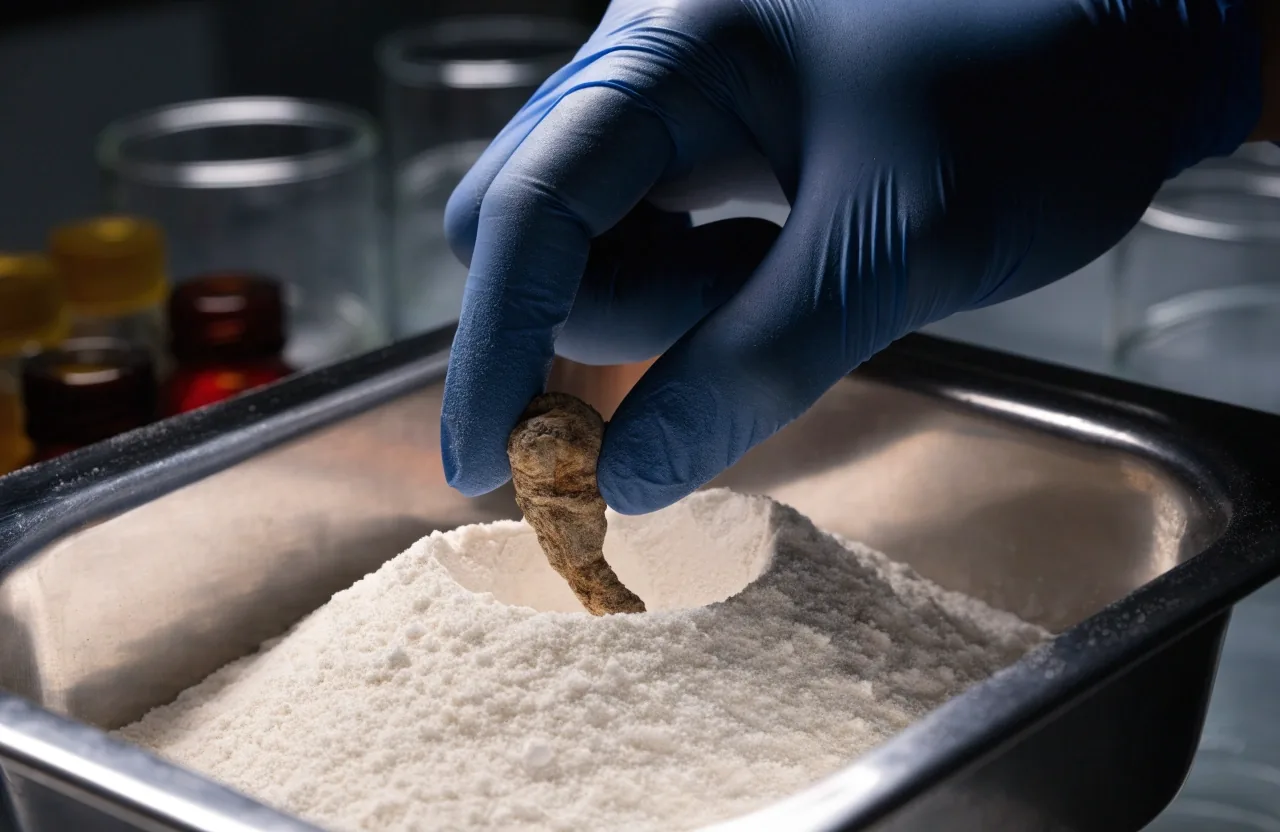
A standardized extract states a percentage of a marker compound, and that percentage means the manufacturer tested the raw material for it. It is the difference between an extract and a plain powder on a label, and it is the only one of the two that gives you a number to compare against another bottle.
Neither version is automatically the right choice for you, and the powder form is not a defect. The point is narrower: when two products list the same herb, the one showing a standardisation percentage is stating something specific, and the one without it is stating something general. Read the extract lines first when you compare.
See also: the ingredient guide for how ginseng, ginkgo, and tribulus are described when a standardisation figure is present.
BPOM registration
For products sold in Indonesia, the registration number is the first thing to find on the pack. Izin edar BPOM appears on compliant packaging, and you can check the printed number against the official register yourself. The check takes a few minutes and it is free.
If a listing does not show a registration number and the seller cannot provide one on request, treat that as a reason to stop rather than a small detail to overlook.
What it tells you
The product is registered in Indonesia and the packaging met the filing requirements. That is the whole claim. It is a compliance fact, and a real one.
What it does not tell you
That the formula suits you, that the doses are the ones you want, or that the herbs were standardised. Those are separate questions you answer from the composition list.
When you buy online
Ask the seller for the printed registration number before ordering. A seller who supplies it quickly is showing you they have the physical pack at hand.
If you are unsure
Write to us with the number and the brand name and we will point you at where to verify it. We are not a register — we just know the route.
See also: the product comparisons page, where every listed format is shown with its registration status.
Third-party verification marks
Outside Indonesia, look for independent verification. Harvard Health's supplement safety guidance recommends the USP Verified mark, and it appears as a quality cue on some U.S. men's multivitamins sold into this market.
The mark exists because supplement quality and the evidence behind individual ingredients vary widely between brands, and testing is not universal. Verification of this kind looks at manufacturing practices and at whether the label matches what is in the bottle. Treat it as a filter that narrows a shelf, not as a recommendation for a particular product, and it will serve you well.
A product can carry BPOM registration, a verification mark, both, or neither, and each says something different about how the pack was handled before it reached you.
BPOM registration
Indonesia's own filing requirement for products sold here. Printed on compliant packaging and checkable against the official register.
USP Verified
An independent verification mark used on some U.S. products, covering manufacturing practice and label accuracy. Recommended as a safety cue by Harvard Health's supplement guidance.
How to use them
Both are filters, not endorsements. They tell you a pack was handled with some discipline; they do not tell you the formula is the right one for you.
Claims that tell you nothing
Phrases on the front of a bottle are chosen for appeal, not precision. Short lines about energy, vitality, or strength are category language: they repeat across brands, they appear on imported and local packs alike, and they are written to be remembered rather than checked.
The back panel is where a product becomes specific. If a front claim has no matching entry in the composition list, the claim is decoration. That single test is the fastest way to compare two bottles standing in a shop, and it needs no expertise — only the willingness to turn the pack over.
A claim that cannot be traced to a line in the facts panel is being made to the shelf, not to you.
See also: the healthy lifestyle guide, for how a supplement fits around food, sleep and training rather than replacing them.

The back panel is the product
Paper photographed as paper — amounts, order, and any percentage on an extract
Hold the bottle to the light and read the panel in one pass from top to bottom. The order you read in is the order the manufacturer wrote in: base vitamins, then named botanicals, then whatever is left in a blend. Nothing on the front changes that sequence.
A five-minute checklist
Five checks, most of them printed in small type at the back of the bottle. Together they answer more questions than a shop assistant can, and you can run them on two products side by side before you decide.
If a product passes all five, it has earned a slower look at whether the formula matches what you actually want from a supplement — not the other way round.
Questions we get asked
Two questions come up more than any others when shoppers write to us about a packet they are holding. Both are answered below.
Every product we describe is a food supplement or a traditional herbal formula, not a medicine.
How do I check a supplement's BPOM registration?
Look for the registration number printed on the packaging, then verify it against the official BPOM register. If you are buying online, ask the seller for the number before you order. A seller who has the physical pack can read it out or photograph it; a seller who cannot may be dropshipping from a listing they have never handled.
Is USP Verified the same as BPOM registration?
No. BPOM registration is Indonesia's own filing requirement for products sold here. USP Verified is an independent verification mark used on some U.S. products and recommended by Harvard Health's supplement safety guidance. A product can carry one, the other, or both — and neither replaces reading the composition list yourself.
Have a pack in front of you that does not add up? Send the brand and the registration number and we will tell you where to verify it. TopVital Indonesia, Jl. Soekarno-Hatta No. 12, Malang, 65141 · +62 341 450 073 · [email protected] · Monday–Friday 09:00–18:00, Saturday 09:00–14:00.
A label you can trace beats a bottle you remember.
See also: natural capsules for strength and vitality on the product comparisons page, where each format is set out in the same order.